Daniel Olliver

AI research · machine learning · quantum computing · Auckland, NZ

Daniel Olliver

I do evidence-first AI research: neural networks that use the exact symmetry of a problem, and quantum experiments on real IBM hardware, with controls and error bars.

Every result on this page comes from a completed, logged run, and the negative results stay in.

Bar chart of the logical observable on IBM hardware: +0.845 ± 0.030 in the vacuum, −0.843 ± 0.035 after the braid, and +0.845 for the control loop, across three devices
Fig. 1Anyon braiding on IBM quantum hardware. Dragging one excitation around another flips the logical observable ⟨Z̄⟩ from +0.845 ± 0.030 to −0.843 ± 0.035, while a control loop stays at +0.845. Reproduced on ibm_marrakesh, ibm_kingston and ibm_fez.
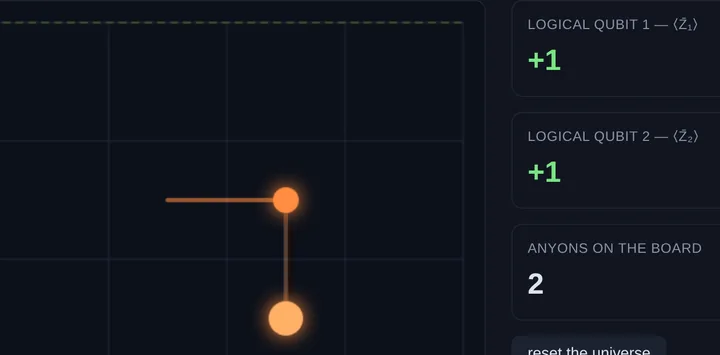
Read the noteBraid anyons yourself

Papers

Two preprints on Zenodo. The DOI opens the full text.

  1. Olliver, D. · Preprint · Zenodo · 16 June 2026

    Circuit-level equivariance is code-dependent: obstruction in the surface code, exactness in the honeycomb Floquet code, and consequences for neural decoders

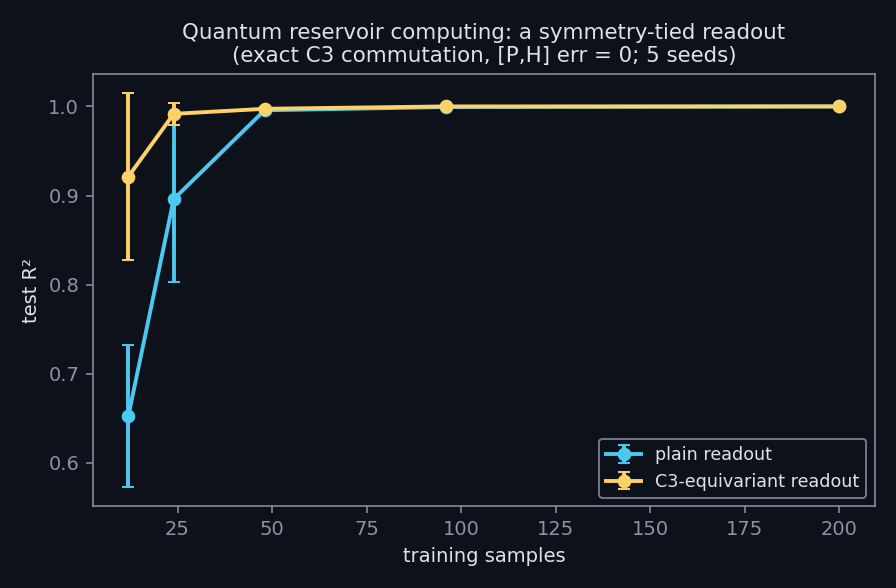
    Whether exact (twisted) equivariance survives at circuit level depends on the code. It is obstructed for surface-code extraction circuits and exact for the honeycomb Floquet code, whose C3 rotation mixes the logical qubits. Tying that symmetry into the decoder flips the honeycomb task from unlearnable to learned.

    • 999 spacetime maps
    • 1,728 schedules
    • ≥256× sample-efficiency separation
    • 116-check audit
    DOI10.5281/zenodo.20715320Read the preprint
    Cite

    Olliver, D. (2026). Circuit-level equivariance is code-dependent: obstruction in the surface code, exactness in the honeycomb Floquet code, and consequences for neural decoders [Preprint]. Zenodo. https://doi.org/10.5281/zenodo.20715320

  2. Olliver, D. · Preprint · Zenodo · 27 July 2026

    The lattice’s teeth: primitive reciprocal axes govern which Fourier components neural cellular automata can grow

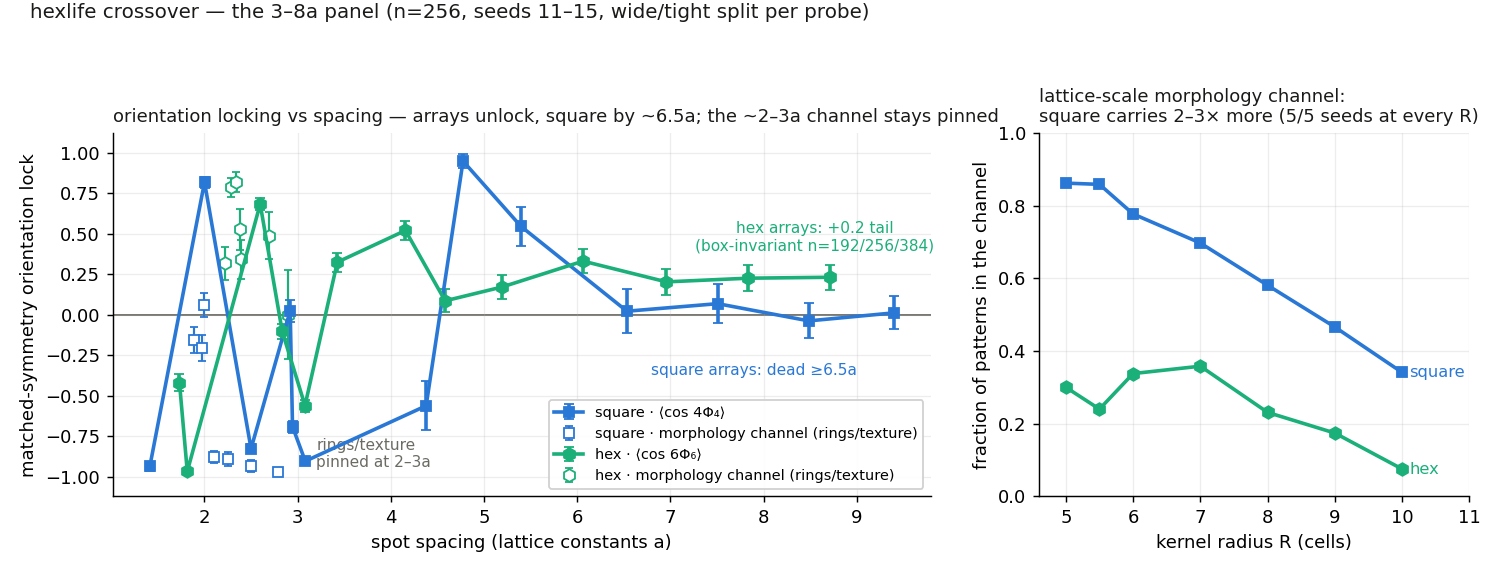
    Neural cellular automata are trained on square grids by default; this paper treats the lattice as an experimental variable. An apparent advantage of hexagonal over square grids turned out to be a normalisation artefact in cross-lattice comparisons, and the paper documents and retracts it. The second result is a primitive-axis rule: a trained NCA grows only the Fourier components whose wavevectors lie on a primitive reciprocal-lattice axis of its grid. A pre-registered out-of-sample test partially refuted that rule as stated. What survives is the gate itself: growth stays direction-selective and no geometry-forbidden component grows, so the constraint is real and soft, not sharp.

    • primitive-axis recovery 0.55–0.88 (restart means)
    • all others ≤ 0.11 (restart means)
    • 96 out-of-sample trainings
    • decider R² −0.39 (needed ≥ 0.8)
    DOI10.5281/zenodo.21614035Read the preprint
    Cite

    Olliver, D. (2026). The lattice’s teeth: primitive reciprocal axes govern which Fourier components neural cellular automata can grow [Preprint]. Zenodo. https://doi.org/10.5281/zenodo.21614035

More on LinkedIn: another research post

Research notes

Seven short write-ups, each with its figure and the result it supports.

Anyon braiding on three quantum computers
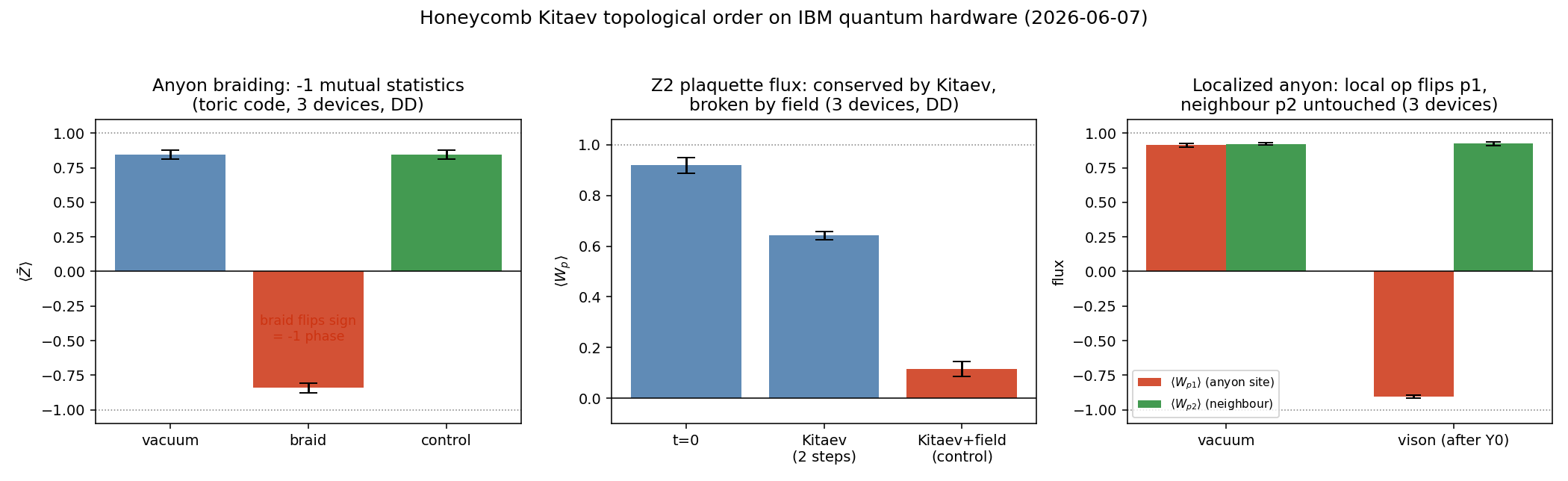
Bar chart of plaquette flux: it stays conserved at +0.64 under the Kitaev evolution and drops to +0.12 under the Kitaev-plus-field control
Bar chart of a localised anyon: after the local operation the anyon plaquette reads −0.905 ± 0.010 while its neighbour stays at +0.924 ± 0.015
Fig. 2Plaquette flux is conserved by the Kitaev evolution and broken by the field control (first panel); a local operation flips one plaquette and leaves its neighbour untouched (second panel).A local operation flips one plaquette to −0.905 ± 0.010 and leaves its neighbour at +0.924 ± 0.015. The flux panel is in the full figure in the note.

Topological order on the Kitaev honeycomb, measured on superconducting hardware with a matched-depth control beside every claim. Fluxes stayed conserved (+0.64) while a control destroyed them (+0.12). A single anyon flipped its plaquette to −0.905 ± 0.010 while the neighbour sat at +0.924 ± 0.015.

ResultThe −1 braiding statistics (Fig. 1), reproduced on ibm_marrakesh, ibm_kingston and ibm_fez with error bars. Not new physics: measured by one person, on three independent machines.
Symmetry-tied neural decoders for quantum error correction

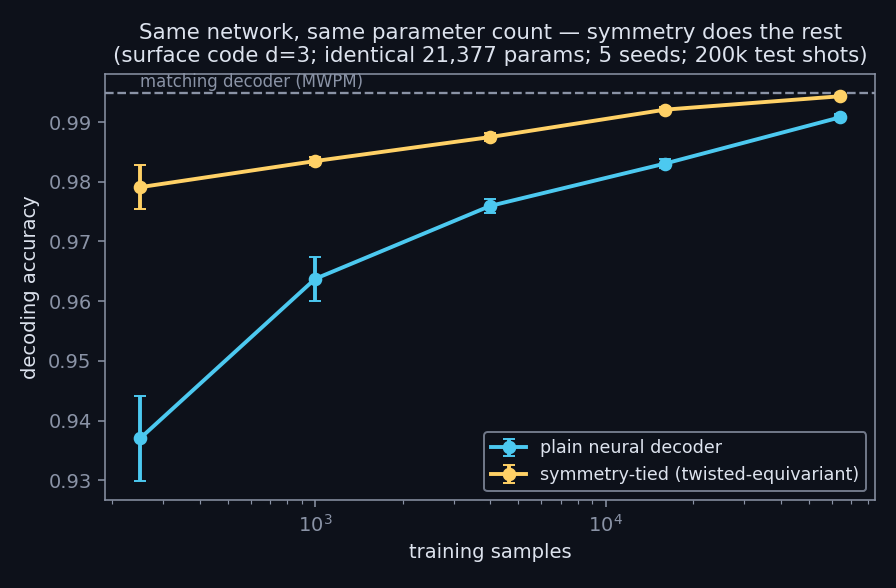
Decoding accuracy against training samples: the symmetry-tied decoder sits above the plain decoder at every size and approaches the matching-decoder line
Fig. 3Surface code d=3 under phenomenological noise (p = 0.008): the same network at an identical 21,377 parameters, 5 seeds, 200k test shots.

A decoder reads a quantum machine’s error alarms and has to name the fault. Labelled data from real devices is scarce, so the right inductive bias matters more than raw scale.

ResultOn the surface code under phenomenological noise, at identical parameter count, the symmetry-tied decoder wins at every training size, is ~4× more sample-efficient, and comes within 0.0005 of the matching-decoder baseline (0.9943 vs 0.9948). On the honeycomb Floquet code, the identical plain twin stays at the majority-class baseline through 64,000 training samples while the symmetry-tied one reaches 0.744 at that size, and the tied net trained on 1,000 samples beats the plain one trained on 256,000.

All seven notes on one page

About

Independent research, 2025–2026.

I’m Daniel Olliver. Through 2025 and 2026 I’ve done independent research in geometric machine learning and quantum computing: more than two dozen controlled experiments on a GTX 1070, free cloud GPUs and three of IBM’s quantum computers.

“No result gets written down before its run completes.”The one rule, from the essay

Early on I caught myself writing numbers for an experiment that was still running. When it finished, reality was backwards from what I’d written. I corrected it and logged the incident: conviction will fabricate evidence if you let it.

The idea I set out to prove, that hexagonal wiring helps a network learn, came back cleanly false. What survived is narrower and more useful: symmetry helps a network when it is exactly present and data is scarce, and topology shows up on real quantum hardware.

Education and teaching
Postgraduate Certificate in AI (University of Auckland)
BSc in Computer Science (AUT)
Graduate teaching assistantUniversity of Auckland, 2024

Contact

Questions about the papers, the code or the runs are welcome.

daniel@danielolliver.com